
Skip to content

Washington University in St. Louis · Missouri

WashU scholarships and merit aid

A highly selective private research university (12% admit rate) that awards merit scholarships through competitive holistic review, not automatic stat-based grids. The three Signature Scholar Programs (Danforth, Ervin, Rodriguez) offer full-tuition with $2,500 stipend or half-tuition awards, while each undergraduate school has its own named school scholarship (Ampersand, Langsdorf, Distinguished Scholars, Conway/Proetz, Fitzgibbon). On average 300+ scholars are enrolled at any given time across the Signature programs. WashU meets 100% of demonstrated financial need without loans.

Verified Jul 20262 months ago

The short answer

Is WashU worth a closer look?

WashU may be worth checking, but its awards do not follow a simple grades-and-scores chart. Start with the published scholarships below.

See our full reasoning

Worth chasing only if your student is a genuine holistic standout — there is no stats-based merit ladder here, and every dollar is a competitive award you must apply for.

WashU runs no automatic, test-score-triggered merit. Every published award — the three Signature programs (Danforth, Ervin, Rodriguez), the school-specific full-tuition awards (Ampersand in Arts & Sciences, Langsdorf in Engineering, Distinguished Scholars in Olin), and the Nemerov writing award — is a competitive holistic selection, not a stats threshold. The biggest computable step is the program tier itself: a $3,000/yr Nemerov award versus a full-tuition award ($71,310 in 2026-27 charges) is a $68,310/yr gap. None reaches the full $102,260 cost of attendance, so even a top award leaves housing, food, and fees to cover — none is a true full ride. Stacking is COA-capped: outside scholarships add on top of WashU aid but total aid cannot exceed $102,260, and government/entitlement grants can force adjustments. Watch the deadlines — Signature apps close January 3, school awards January 2, Nemerov priority December 16.

Merit tiers9See who qualifies
First-year students with school awards2%First-year students, CDS 2024-2025 (school-estimated)
Research checkedJul 2026By our research team
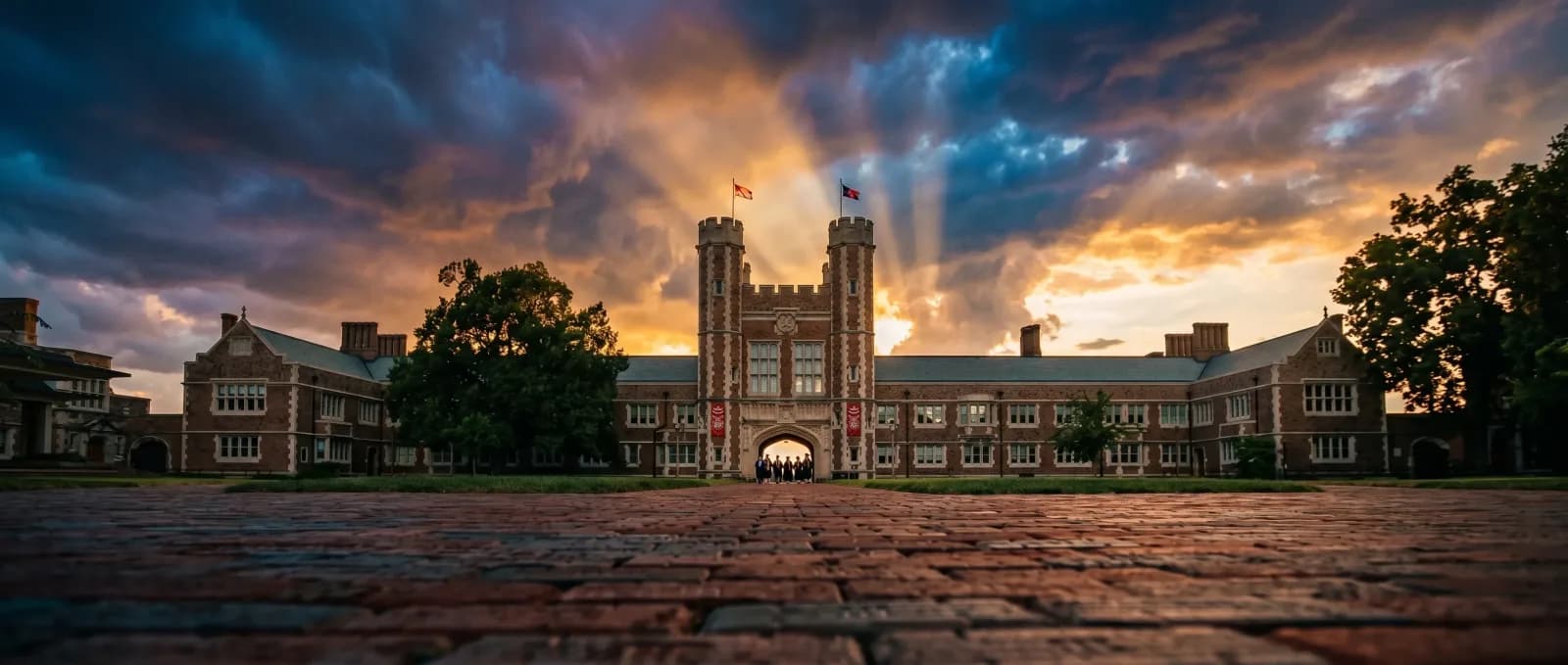
Brookings Hall at Washington University in St. Louis

Free Merit Check

See what WashU's published rules mean for your student. Takes 30 seconds.

Checking merit aid at WashU

We’ll email you this result and a few short merit-aid pointers. We store score ranges only, never your student’s name. Unsubscribe anytime. See our privacy policy.

Published scholarships

These amounts and requirements come from the school’s own published pages. Open an award to see who qualifies and how to keep it.

Full-tuition scholarship with…Full-tuition scholarship with $2,500 annual stipend, or half-tuition scholarship

Danforth Scholars Program

Apply separatelyCan continue
See who qualifies
Who qualifies

Competitive holistic review. Must complete a separate Danforth Scholars application with 250-word short-answer essays by January 3. Applicants may also apply to Ervin and Rodriguez programs simultaneously. Finalists notified by end of February. Mandatory virtual events and March interview required to remain eligible. Seeks students who demonstrate leadership in service, intellectual and creative acuity, commitment to diversity, and kindness.

How to keep it

Annually renewable. Scholars must continue to satisfy the expectations of their program. No specific renewal GPA threshold is published on scholars.washu.edu, but the financial aid office requires a minimum 2.0 GPA for general aid eligibility.

Notes

Named after Dr. William H. and Elizabeth Gray Danforth. Part of the three Signature Scholar Programs administered by the Office of Scholar Programs. On average 300+ total scholars are enrolled across all three Signature programs at any given time. International students are eligible.
Source

Full-tuition scholarship with…Full-tuition scholarship with $2,500 annual stipend, or half-tuition scholarship

John B. Ervin Scholars Program

Apply separatelyCan continue
See who qualifies
Who qualifies

Competitive holistic review. Must complete a separate Ervin Scholars application by January 3. Only U.S. citizens, permanent residents, and undocumented or DACA students living in the U.S. are eligible. Finalists notified by end of February with mandatory March interview. Seeks academic excellence, demonstrated initiative and community leadership, a history of bringing diverse groups together, commitment to community service, perseverance through adversity, and service to historically underprivileged populations.

How to keep it

Annually renewable. Scholars must continue to satisfy program expectations and maintain steady progress toward degree completion.

Notes

Named after Dr. John B. Ervin, a nationally renowned educator and community leader. Founded in 1986. Five Ervin graduates have been named Rhodes Scholars. Part of the Signature Scholar Programs. Includes the sERVIN flagship community service initiative.

Source

Full-tuition scholarship with…Full-tuition scholarship with $2,500 annual stipend, or half-tuition scholarship

Annika Rodriguez Scholars Program

Apply separatelyCan continue
See who qualifies
Who qualifies

Competitive holistic review. Must complete a separate Rodriguez Scholars application by January 3. Finalists notified by end of February with mandatory March interview. Seeks students of exceptional merit who demonstrate academic and leadership achievements, passion for community service, and commitment to bringing diverse groups together and celebrating different cultures. International students are eligible.

How to keep it

Annually renewable. Scholars must maintain high academic achievement throughout their college careers and make steady progress toward degree completion.

Notes

Named after Annika Lynn Rodriguez (Olin Business School, Class of 1996), who joined the Peace Corps after graduation and was tragically killed in a flash flood in Honduras. Part of the Signature Scholar Programs.

Source

Full tuition with $1,000 annual sti…Full tuition with $1,000 annual stipend

Ampersand Scholarships (College of Arts & Sciences)

Apply separatelyCan continue
See who qualifies
Who qualifies

Must apply to the College of Arts & Sciences. No separate application required - selected based on admissions application review. The committee pays particular attention to the applicant's response about interests in studying subjects that cross at least two of the three major areas of Arts & Sciences (Humanities, Natural Sciences, Social Sciences). Up to 16 awards per year. Application deadline January 2.

How to keep it

Renewable annually as long as the scholar is making satisfactory progress toward a degree.

Notes

Scholars receive priority review for Ampersand Programs in their first year if submitted within 24 hours of the application window opening. Notification by end of February.

Source

Full tuition with $1,000 annual sti…Full tuition with $1,000 annual stipend

Alexander S. Langsdorf Fellowships (McKelvey School of Engineering)

Apply separatelyCan continue
See who qualifies
Who qualifies

Must apply to the McKelvey School of Engineering. No separate application required - faculty review admissions application materials. Up to 10 awards per year. Seeks incoming students who display outstanding academic achievement, particularly in science and mathematics. Application deadline January 2.

How to keep it

Renewable annually with satisfactory academic progress. Covers tuition and laboratory fees for degree-required courses.

Notes

Established in 1966 by then-Dean James M. McKelvey. Named after Alexander S. Langsdorf, who served as Dean of Engineering for 30 years. Notable alumnus W. E. Moerner received the 2014 Nobel Prize in Chemistry. Notification by end of February.

Source

Full tuition

Distinguished Scholars Program (Olin Business School)

Apply separatelyCan continue
See who qualifies
Who qualifies

Must apply to Olin Business School. No separate application required - selected based on admissions application review. Up to 10 awards per year. Seeks outstanding character, academic achievement, promise for a career in business, and outstanding leadership and community service potential. Application deadline January 2.

How to keep it

Renewable annually as long as the scholar is making satisfactory progress toward a degree.

Notes

Notification by end of February.

Source

Up to one full-tuition scholarship…Up to one full-tuition scholarship and up to five partial-tuition scholarships per year

Conway/Proetz Scholarship in Art (Sam Fox School)

Apply separatelyCan continue
See who qualifies
Who qualifies

Must apply to the College of Art in the Sam Fox School of Design & Visual Arts. Must submit a digital portfolio of 10-20 pieces of recent work (drawings, paintings, sculpture, photographs, illustrations, videos, etc.). Application deadline January 2. Finalists notified by end of February with mandatory virtual interview.

How to keep it

Renewable annually as long as the scholar is making satisfactory progress toward a degree.

Notes

Recognizes superior artistic and academic performance. The award alternates annually between the Fred Conway Scholarship and the Esther & Arthur Proetz Scholarship. Scholars announced in early March.

Source

Up to one full-tuition scholarship…Up to one full-tuition scholarship and up to five partial-tuition scholarships per year

James W. Fitzgibbon Scholarship in Architecture (Sam Fox School)

Apply separatelyCan continue
See who qualifies
Who qualifies

Must apply to the College of Architecture in the Sam Fox School. Must submit a digital portfolio of 10-20 pieces of recent work. Candidates must be pursuing a Bachelor of Science or Bachelor of Arts in Architecture. Application deadline January 2. Finalists notified by end of February with mandatory virtual interview.

How to keep it

Renewable annually with satisfactory academic progress.

Notes

Recognizes outstanding scholastic potential for a professional career in architecture and creative ability demonstrated through portfolio. Scholars announced in early March.

Source

$3,000 per year

Howard Nemerov Writing Scholars Program (College of Arts & Sciences)

Apply separatelyCan continue
See who qualifies
Who qualifies

Must apply to the College of Arts & Sciences. Requires a separate writing portfolio submission of two samples of creative writing, preferably in different genres (e.g., one short story and a group of poems, or a short play and a piece of creative nonfiction). Priority consideration deadline December 16. Up to 10 awards per year. Must commit to earning a minor in English writing.

How to keep it

Renewable annually as long as the scholar is making satisfactory progress toward a degree.

Notes

Scholars participate in the Howard Nemerov Writing Seminar, submit work to campus publications, and attend writing-related social activities.

Source

See what could change an award

Rules that could change the answer

These are the rules we would flag for your family. Each comes from WashU's published information.

  • Cutoff cliffOne ACT point can move the award by +$68,310/yr ($71,310 tuition − $3,000 Nemerov)

    WashU publishes a tier ladder where crossing Nemerov writing award → any full-tuition award (Ampersand / Langsdorf / Distinguished) changes the marginal value by +$68,310/yr ($71,310 tuition − $3,000 Nemerov). The largest computable step across the published tiers. Driven entirely by program selection, not stats.

  • Aid capHard $102,260 cost-of-attendance ceiling

    Institutional aid at WashU cannot push the package past $102,260. Big outside wins can mathematically reduce institutional grant once the ceiling is reached.

Straight from the aid office

What WashU's aid office says

Per Student Financial Services, Washington University in St. Louis, August 2026. How we verify

Outside scholarships

How does an outside scholarship affect a WashU aid package?

WashU adjusts its own financial aid when a student on WashU aid brings in outside scholarships. The office did not specify what is reduced first — loans, work expectation, or grant — so families should ask for the specific ordering before committing an outside award. The quote is reproduced exactly as written.

“Outside awards- If you student gets financial aid through WashU and they are receiving outside scholarships; WashU will adjust the WashU financial aid.”
Annual refiling

What keeps aid flowing each year?

Both forms, every year — the FAFSA and the CSS Profile must be refiled annually to continue receiving aid from WashU. There is no rollover here.

“Every year the student must fill out FAFSA and CSS Profile to continue to receive financial aid from the school”
Deadline notifications

How do families learn the aid and scholarship deadlines?

By opting into WashU emails — students signed up for university email receive the deadline notices for scholarships and financial aid. The office gave no calendar dates in writing, so the mailing list is the operative reminder system.

“If your student signed up to receive emails from WashU they will receive emails about deadlines for scholarships, financial aid etc”

What families often miss

  1. WashU does not publish an SAT, ACT, or GPA grid that triggers automatic merit aid. All scholarships are competitively awarded through holistic review. The school-level scholarships (Ampersand, Langsdorf, Distinguished Scholars) are awarded based on admissions application review, but they are not formulaic - a faculty committee selects recipients. The Signature Scholar Programs require a completely separate application with essays and interviews. Families accustomed to automatic merit grids at schools like Alabama, Arizona, or Ole Miss will not find the same system here.

  2. The Danforth, Ervin, and Rodriguez Scholars Programs all require a separate application with 250-word essays submitted by January 3. This is not the same as the January 2 admissions application deadline. Students who apply only through the standard admissions process will not be considered for Signature Scholar awards. You can apply to multiple Signature programs simultaneously, but each requires its own essay responses.

  3. Beyond the three university-wide Signature Scholar Programs, each school offers its own named awards: Ampersand (Arts & Sciences, up to 16 full-tuition), Langsdorf (Engineering, up to 10 full-tuition), Distinguished Scholars (Olin Business, up to 10 full-tuition), Conway/Proetz (Art, up to 6 awards), and Fitzgibbon (Architecture, up to 6 awards). Students are only eligible for the scholarship tied to their chosen school. The Sam Fox School scholarships require portfolio submissions. Families who focus only on the Signature programs may overlook the school-specific opportunities.

  4. The WashU Pledge is a need-based full-ride program for Missouri and eligible Illinois families earning $75,000 or less. It is not a merit award and requires financial aid applications (FAFSA and CSS Profile). However, eligible families who are also strong merit candidates can potentially receive both a merit scholarship and need-based aid, subject to the cost-of-attendance cap.

See award cutoffs and special programs

What each program is worth

Every WashU merit award is competitive and requires a separate application or school-specific review — none is triggered by GPA or test scores. Rows ascending by dollar value.

Student profileLikely outcome
A&S applicant · creative writing portfolio · Dec 16 priorityHoward Nemerov Writing Scholars — $3,000/yrSmallest named tier; requires committing to an English writing minor. Up to 10 awards/year.
Olin Business applicant · holistic reviewDistinguished Scholars (Olin) — full tuition ($71,310/yr)No separate application; selected from admissions review. Up to 10 awards/year. Tuition only — does not cover the ~$31k of housing, food, and fees.
A&S or Engineering applicant · holistic reviewAmpersand or Langsdorf — full tuition + $1,000/yr stipendNo separate application. Ampersand: up to 16/year (cross-disciplinary interest); Langsdorf: up to 10/year (science/math strength).
Signature Scholars finalist · separate app + March interviewDanforth / Ervin / Rodriguez — full tuition + $2,500/yr stipend, or half tuitionHighest total package. Competitive holistic review with mandatory interview; ~300+ scholars enrolled across all three programs. Award may instead be half tuition.

Where the dollars actually move

These are deltas between named WashU tiers. Note: WashU publishes no automatic stats threshold, so none of these is a test-prep cliff — the lever is which program you target and win.

ThresholdMarginal value
Nemerov writing award → any full-tuition award (Ampersand / Langsdorf / Distinguished)+$68,310/yr ($71,310 tuition − $3,000 Nemerov)The largest computable step across the published tiers. Driven entirely by program selection, not stats.
Full-tuition + $1,000 stipend (Ampersand/Langsdorf) → Signature full-tuition + $2,500 stipend+$1,500/yr stipend ($2,500 − $1,000)Tuition is identical; only the stipend grows. Signature also requires a separate app and March interview the school awards do not.
See costs and school data

Who this school may work for

Families of high-achieving students who want to understand that WashU does not offer automatic merit based on GPA or test scores. Every merit scholarship at WashU requires competitive holistic review, and most require a separate application with a January 3 deadline. Students who apply only through the standard admissions process without opting into the scholarship applications will be considered only for their school's automatic-consideration scholarship (Ampersand, Langsdorf, Distinguished Scholars). The Signature Scholar Programs seek leadership, service, and diversity commitment, not just academic stats. Missouri and Illinois families earning under $75,000 should also evaluate the WashU Pledge, which covers tuition, fees, room, and board for four years.

Cost of attendance$102,260 for 2026-2027Each bar is the full published cost for that scenario, sized against the highest figure so totals compare at a glance.
On-campus$102,260
  • Tuition & fees
  • Housing & food
  • Books
  • Travel
  • Personal

Full COA; required health insurance billed separately and not itemized on COA page (excluded).

WashU cost-of-attendance source

Cost and graduation facts

Federal reporting on who actually enrolls at WashU, what they paid after aid, and what happened next — independent of anything the school markets.

Average annual net price by family income at WashU, academic year 2021-22
Family incomeAverage net price paid
$0–$30,000$1,716
$30,001–$48,000$1,928
$48,001–$75,000$5,578
$75,001–$110,000$12,603
$110,001+$42,170
All income levels (average)$21,786

Sticker price vs. what students actually pay

Published tuition & fees, AY 2022-23
$65,790
Average net price paid (all Title-IV aid), AY 2021-22
$21,786

That works out to roughly a 75% discount below the federal AY 2021-22 average cost of attendance of $88,488 (College Scorecard — a separate, federally reported figure, not the published cost of attendance shown above).

Outcomes for students who enrolled here

Graduation rate (150% of normal time), 2016 cohort
94%
First-year retention rate, 2021 cohort
95%
Median debt at completion, 2020–2021 completers
$17,500 (~$186/mo on a 10-yr plan)
Median earnings, 10 years after entry (measured 2020-21)
$86,182
Share of students receiving a Pell grant, AY 2021-22
21%
Share of students receiving a federal loan, AY 2021-22
6%
See other scholarships and cost examples

If your student brings another scholarship

Outside scholarships do not automatically reduce WashU need-based or merit-based financial aid. They are generally added to the existing aid offer, but total aid from all sources cannot exceed the cost of attendance.

WashU's published policy states that receiving an outside scholarship does not automatically reduce a student's need-based or merit-based financial aid. These scholarships are generally added to the existing financial aid offer. However, the total amount of aid, including outside scholarships, cannot exceed the total cost of attendance for the academic year. Federal and state government grants and certain entitlement grants (state scholarships, SEOG, veterans benefits, employer tuition benefits) may trigger adjustments to WashU institutional aid since those programs have specific federal restraints. Students must report all outside scholarships to Student Financial Services by submitting award documentation.

Source

More school data

From the WashU Common Data Set 2024-2025 (school-estimated figures):

Merit penetrationHow likely is merit aid here?From WashU’s Common Data Set: the share of first-year students who receive institutional merit and the average dollar amount when they do.
2%of admitsget merit
Average award$42,765Covers ~42% of $102,260 cost of attendance

At WashU, roughly 1 in 50 first-year admits receive institutional merit aid. The average award is $42,765about 42% of total cost.

As filed in WashU's CDS Section H2A: of 1,843 first-time, full-time degree-seeking freshmen, 42 had no financial need and received institutional merit (non-need) scholarship or grant aid, averaging $42,765. Across all full-time degree-seeking undergraduates: 198 of 7,509, averaging $44,562. Athletic awards are excluded per the CDS definition.

The 2024-2025 column is marked "estimated" in the school's own CDS filing — school-projected figures, not final audited counts.

Test-score figures below come from the 2024-2025 Common Data Set.

SAT mid-50%1490–157025th / 75th percentile, Common Data Set 2024-2025
ACT mid-50%33–3525th / 75th percentile, Common Data Set 2024-2025
Receive institutional merit2%First-year students, Common Data Set 2024-2025 (school-estimated)
Average merit award$42,765Across recipients, Common Data Set 2024-2025 (school-estimated)

Source: Common Data Set 2024-2025 (verified 2026-07-23)

Source: Common Data Set 2024-2025 (test scores)

Other WashU scholarships worth checking

These awards can be harder to find. Each one has its own rules.

Amount100% of demonstrated need met without loans, plus $1,500 Start-Up Grant, first-year laptop with 4-year warranty, up to two $5,000 grants for summer research/internships/study abroad, and waiver of $1,550 summer earnings expectationEligibilityFirst-generation college and limited-income students pursuing STEM degrees with social impact goals. Up to 20 awards per year. No separate application required - automatic consideration based on admissions and financial aid applications.

Housed within the Taylor Family Center for Student Success. Includes fully funded pre-orientation program, academic advising, career development programming, and connection to the Gephardt Center for Community Engagement. This is a need-based-plus-merit hybrid, not a pure merit scholarship.

Source

AmountHalf tuition, renewable for four years, plus eligibility for a $5,000 summer stipend each year (after first, sophomore, and junior years) for internships or similar experiencesEligibilityMust be a graduate of the Ensworth School in Nashville, Tennessee. Awarded on the basis of financial need. No separate application required. Up to two awards per year.

Named after Dr. Thomas F. Frist, Jr., co-founder of Hospital Corporation of America (HCA), who received his medical degree from WashU in 1965. Summer stipends are applied for through The Career Center.

Source

AmountFull ride covering tuition, fees, housing (modern double room), and meals (Platinum plan on-campus, Silver plan off-campus), guaranteed for four years. Average WashU Pledge aid package was $90,377 in 2025.EligibilityMust reside in or attend high school in Missouri, or reside in or attend high school in one of 53 defined counties in Illinois. Family annual income must be $75,000 or less. Must be a U.S. citizen or permanent resident. Must be a full-time undergraduate student (not School of Continuing & Professional Studies).

This is a need-based program, not a merit scholarship. However, families often overlook it when evaluating WashU affordability. Recipients also receive the First-Year Startup and Technology Grants. No repayment required. Requires FAFSA and CSS Profile filing. Announced by Chancellor Andrew D. Martin in 2019.

Source

WashU merit aid FAQ

  • Does WashU offer automatic merit scholarships based on GPA or test scores?

    No. WashU does not publish an automatic GPA or test score grid for merit aid. All merit scholarships are competitively awarded through holistic review. The school-level scholarships (Ampersand, Langsdorf, Distinguished Scholars) are selected by faculty committees reviewing the admissions application, and the Signature Scholar Programs (Danforth, Ervin, Rodriguez) require a separate application with essays and interviews. The enrolled middle 50% SAT is 1490-1570 and ACT is 33-35 (per the 2024-2025 Common Data Set), but hitting those scores guarantees nothing.

  • How many merit scholarships does WashU award each year?

    Across all programs: up to 16 Ampersand (Arts & Sciences), up to 10 Langsdorf (Engineering), up to 10 Distinguished Scholars (Olin Business), up to 6 Conway/Proetz (Art), up to 6 Fitzgibbon (Architecture), up to 10 Nemerov Writing Scholars, plus Signature Scholar awards across the Danforth, Ervin, and Rodriguez programs. On average 300+ total Signature scholars are enrolled at any given time across all class years. The exact number of new Signature awards per year is not published.

  • Can I apply to multiple scholarship programs at the same time?

    Yes. You may apply to more than one of the Danforth, Ervin, and Rodriguez Signature Scholar Programs simultaneously. Each requires its own essay responses. You are also automatically considered for your chosen school's scholarship (Ampersand, Langsdorf, Distinguished Scholars) through the admissions application. There is no cost to apply to any of these programs.

  • Are international students eligible for merit scholarships?

    International students are eligible for the Danforth and Annika Rodriguez Scholars Programs, as well as the school-level scholarships (Ampersand, Langsdorf, Distinguished Scholars, Conway/Proetz, Fitzgibbon). The John B. Ervin Scholars Program is restricted to U.S. citizens, permanent residents, and undocumented or DACA students living in the U.S.

  • How does WashU handle outside scholarships?

    Outside scholarships do not automatically reduce WashU need-based or merit-based financial aid. They are generally added to the existing aid offer. However, total aid from all sources cannot exceed the cost of attendance. Federal and state grants may trigger adjustments due to federal program restrictions. Students must report all outside scholarships to Student Financial Services.

  • What is the WashU Pledge and who qualifies?

    The WashU Pledge is a need-based full-ride program (not a merit scholarship) for admitted students who reside in Missouri or one of 53 defined Illinois counties, with family income of $75,000 or less. It covers tuition, fees, housing, and meals for four years. U.S. citizens and permanent residents who are full-time undergraduates are eligible. Requires FAFSA and CSS Profile. The average WashU Pledge aid package was $90,377 in 2025.

See sources and other schools

How WashU compares

  • 235 of 749 verified schools in our dataset use cost-of-attendance cap displacement.

    WashU is in a recognizable cluster (235 schools share this category). That framing matters when comparing peer schools that may publish the policy differently or not at all.

  • 665 of 749 verified schools publish at least one four-year renewable merit award.

    WashU is one of them. The cohort minority (84 schools) only awards one-year scholarships, which means the four-year value families assume on a brochure quote isn't guaranteed at every school.

  • 63 of 749 verified schools publish a marginal-value cliff table we can quantify.

    WashU is one of them. Most schools won't tell families what one ACT point is actually worth. At the schools that do, a strategic retake is sometimes mathematically more valuable than test-optional positioning.

Sources used on this page

Every claim is checked against WashU’s own published materials. Below is the full reference set.

Compare with similar schools

  • Drury merit aid. Missouri private school — compare automatic merit, amounts, and stacking.
  • Mizzou merit aid. Missouri public university — compare automatic merit, amounts, and stacking.
  • Avila merit aid. Missouri private school — compare automatic merit, amounts, and stacking.
  • Central Missouri merit aid. Missouri public university — compare automatic merit, amounts, and stacking.

Keep exploring WashU merit aid

Planning guides for WashU